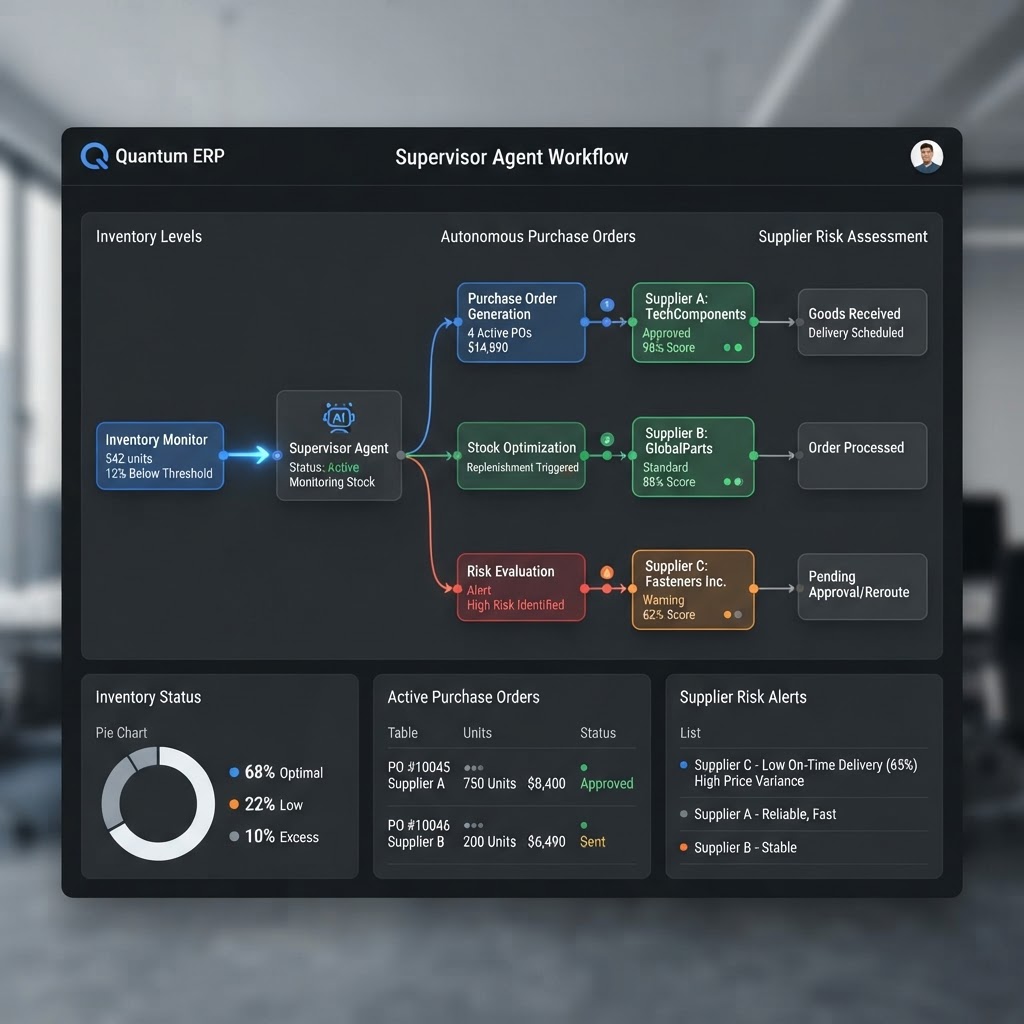
The Execution Gap: Why Forecasting Is No Longer Enough
For most mid-market organizations, the decision to migrate from entry-level accounting software like QuickBooks or Xero is rarely driven by a single transaction limit. Instead, it is driven by the 'Execution Gap'—the mounting friction between receiving an alert and taking corrective action. In a legacy or fragmented environment, an inventory alert is merely a signal that requires human intervention: a buyer must evaluate supplier lead times, a warehouse manager must check space, and a customer service rep must update the CRM. This manual chain of events is where profitability leaks occur.
As of 2025 and looking into 2026, the market has shifted from predictive AI (which forecasts what might happen) to Agentic AI ERP (which acts on those forecasts). This article examines the strategic shift required for operations and finance leaders to move beyond simple automation toward autonomous 'Supervisor Agents' that manage inventory and supply chain variability without constant human oversight.
Predictive vs. Agentic: The Shift in Operations Intelligence
To evaluate an AI ERP for small business or midsize growth, it is essential to distinguish between the two primary AI architectures available today. Legacy ERPs and high-end accounting systems often utilize predictive models. These systems analyze historical data to suggest reorder points or identify seasonal trends. However, the human is still the primary operator.
Agentic AI ERP introduces 'Supervisor Agents.' Unlike a static script, these agents can navigate multi-variable disruptions. For example, if a supplier in a specific region reports a 10-day delay due to logistics constraints, a predictive system would simply flag the late delivery. An agentic system, such as those being integrated into Vanteliq-standard environments, can autonomously:
- Evaluate alternative suppliers based on pre-vetted reliability scores.
- Draft a purchase order for the shortfall.
- Update the CRM to notify sales teams of potential fulfillment delays for specific high-value accounts.
- Recalculate the cost of goods sold (COGS) based on the new logistics pricing.
This move from 'alert' to 'execution' is the primary differentiator for all-in-one business operations software in the current 2026 landscape.
Native Features vs. Third-Party Integrations: The Inventory CRM Accounting ERP Nexus
When selecting a platform for ERP for midsize business, the architecture of inventory management—whether native or integrated—has profound implications for data latency. Not all systems are built equally for AI inventory forecasting and execution.
NetSuite and Odoo: Native Modular Depth
Platforms like NetSuite and Odoo offer extensive inventory and warehouse management modules natively. Because the inventory records reside in the same database as the general ledger and the CRM, an AI agent can access real-time data without the lag associated with API calls. In an Odoo environment, for instance, a 'Supervisor Agent' can monitor stock levels and manufacturing orders simultaneously because the data structures are unified.
Sage Intacct and Business Central: The Integration Challenge
In contrast, systems like Sage Intacct often excel at core financials but may require third-party integrations (such as Inventory Navigator or specialized WMS tools) for complex inventory needs. While powerful, these integrations can introduce 'data lag.' If your AI agent relies on a 15-minute sync interval to determine stock levels, it may execute a purchase order based on outdated information. Furthermore, as of mid-2026, many vendors have introduced API surcharges for high-frequency data polling, which can add thousands to the annual operating cost of an agentic workflow.
The Reality of ERP Implementation Cost (2025-2026 Benchmarks)
Transparency regarding ERP implementation cost is vital for CFOs evaluating outgrowing QuickBooks. Transitioning to a mid-market ERP is not merely a software subscription; it is a capital project. Based on current market data, the following pricing benchmarks apply:
- Initial Investment: Total first-year investment for a mid-market ERP typically ranges from $20,000 to $125,000 for standard implementations.
- Per-User SaaS Fees: Entry-level seats for Business Central range from $70/month, while SAP S/4HANA Public Cloud or specialized NetSuite configurations often exceed $200/month.
- Implementation Multiplier: Expect a 1.5x to 2x multiplier on software costs for implementation labor, data migration, and agent training.
- Five-Year TCO: Per-user budgets for business profitability software average approximately $7,200 over a five-year horizon when accounting for upgrades, maintenance, and API fees.
Mitigating the Risks of Agentic Migration
The promise of autonomous inventory management comes with specific operational risks that must be managed during the migration phase.
1. The Data Cleanup Hurdle
AI agents are only as effective as the data they ingest. If historical records in your current accounting software are inconsistent—such as varying units of measure for the same SKU—an AI agent will 'hallucinate' reorder recommendations. Significant time must be allocated to data cleansing before the 'Go-Live' date.
2. API and Integration Surcharges
Many legacy cloud ERP vs legacy ERP comparisons fail to account for high-frequency API calls. Agentic workflows require constant communication between modules. Vendors like NetSuite may charge separate tiers for the API bandwidth required to run autonomous agents at scale. Disclosing these potential hidden fees is a prerequisite for any decision-oriented evaluation.
3. The 3-6 Month Productivity Dip
Operations leaders must prepare for a temporary dip in productivity post-migration. Transitioning from the 'open' nature of QuickBooks to the granular, permission-based workflows of a professional ERP requires team retraining. Internal data across the industry suggests a near 100% likelihood of a 15-20% decrease in operational speed during the first quarter as staff adjust to new controls and agent-monitored processes.
NetSuite vs Odoo vs Business Central vs Sage Intacct: At a Glance
Feature/MetricNetSuiteOdooBusiness CentralSage IntacctInventory ArchitectureNative / DeepNative / ModularNative / Mid-tierOften IntegratedAgentic ReadinessHigh (Oracle Agentic AI)High (Open Source/Custom)Moderate (Copilot)Moderate (Financial focus)Pricing ModelAnnual ContractPer User / AppPer UserModule-basedBest ForGlobal Mid-MarketSMB FlexibilityMicrosoft EcosystemFinance-Heavy Firms
Strategy: How to Execute the Transition
For COOs and CFOs ready to bridge the execution gap, the migration should follow a phased approach rather than a 'big bang' implementation:
- Phase 1: Transaction Audit. Identify exactly where human intervention is currently required in your inventory cycle. If your team spends more than 10 hours a week manually drafting POs, you have reached the threshold for agentic intervention.
- Phase 2: Pilot the Supervisor Agent. Before allowing an AI agent to execute live orders, run it in 'Draft Mode.' Allow the agent to suggest POs and reroute shipments, but require a human sign-off for the first 90 days to validate the logic against real-world supplier reliability.
- Phase 3: Permission-Based Scaling. Gradually increase the agent’s autonomous limits (e.g., allow the agent to auto-approve any PO under $5,000 with a pre-vetted supplier).
Conclusion
The transition from ERP vs accounting software is no longer just about having a better general ledger; it is about deploying an operational brain capable of executing tasks. While the ERP implementation cost and the initial productivity dip are significant, the ability of an agentic AI ERP to close the execution gap in inventory management is the primary driver of mid-market scaling in 2026. Decisions should be based on data quality and native architecture rather than marketing claims of 'instant' ROI.
Is your current system creating an execution gap? Request an ERP fit assessment to evaluate your operational readiness for agentic AI migration.